
Pride and prejudice
an adaptation by Gary Andrews of the classic Jane Austin novel
Synopsis
First published in 1813, Jane Austen’s Pride and Prejudice charts the emotional development of the protagonist, Elizabeth Bennett, who learns the error of making hasty judgements and comes to appreciate the difference between the superficial and the essential. Her father, Mr Bennett of the Longbourn Estate, has five daughters, but his property is entailed, meaning that none of the girls can inherit it. His wife has no fortune, so it is imperative that at least one of the girls marry well in order to support the other upon his death.
Gary Andrew’s dramatisation enchantingly captures all the essential events and relationships from Austen’s novel in a series of wonderful vignettes which will amuse and delight the audience and players alike.

Photos
Cast & Crew
Cast
Elizabeth Bennet – Beckie Wilkes
Jane Bennet – Lizzie Mills
Mary Bennet – Phoebe Sleeman
Kitty Bennet – Lily Brown
Lydia Bennet – Katie Bartholomew
Mr Bennet – Richard Peachey
Mrs Bennet – Sophie MacTavish
Mr Darcy – Sean Eldridge
Mr Bingley – Peter Calver
Caroline Bingley – Catherine Elliott
Charlotte Lucas – Philippa Lucas
Sir William Lucas – Alan Webber
Mr Collins – Steve Jones
Lady Catherine de Bourgh – Joanna Silcox
Georgiana – Beth Mesher
Colonel Fitzwilliam – Ian Caldecourt
Mr Gardiner – Mike Tomlin
Mrs Gardiner – Carol Moss
Mrs Reynolds – Jackie Barrett
Anne de Bourg – Annette Spanton
Footman – Ernie McGirr
Denny – James Saunders
George Wickham – Danniel Horton
Ensemble:
Sonia Harder, Ernie McGirr, Annette Spanton, Liz Stott
Crew
Director – Peter Reed
Choreographer – Nicky Roberts
Review
NODA Review
This Jane Austen classic story has been re-popularised in fairly recent times because of the TV series featuring Colin Firth as Mr Darcy. It is a deeply layered story and a little difficult to follow to those not already familiar with the book – or TV series.
Centreing round the five unmarried Bennet daughters and the fierce determination of their mother, Mrs Bennet to see them all married, it is also a clear example of the social class and rigid sexism of the Regency period.
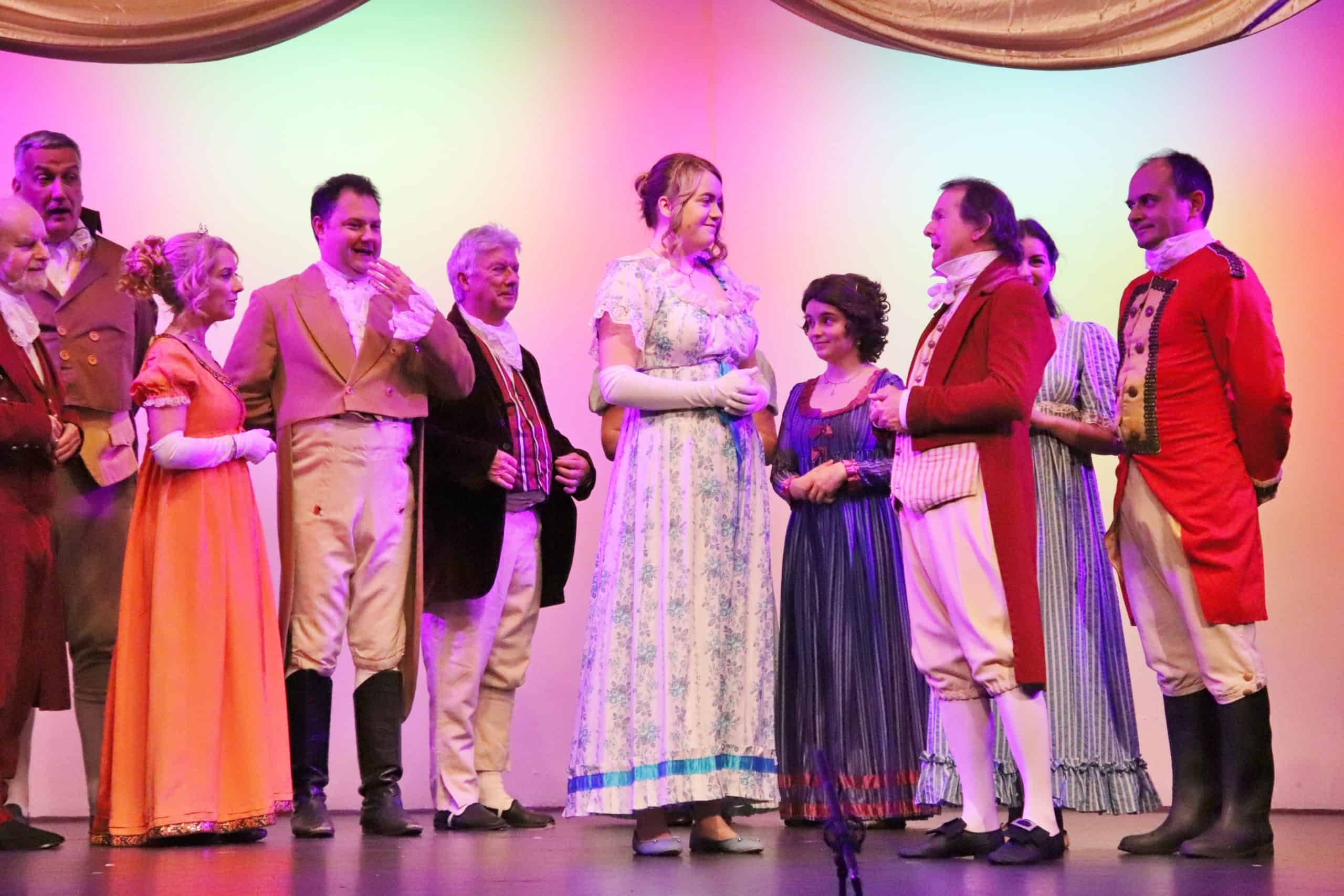
Splendidly suitable period costumes with excellent ladies’ gowns and the men also handsomely attired – with the sole exception of one gentleman whose buttoned red jacket was obviously too tight (despite he himself not being of above average girth) – made for a realistic feel to the piece. Importantly, wigs, hair and make up were of a standard matching the costumes, courtesy of Stephanie Hornett Johnson assisted by Beckie Wilkes.
The mannerly way of speaking by all main characters was well observed too, with crisp, well enunciated and easy to understand dialogue; not something I am able to note, in amateur plays elsewhere.
Choreographer Nicky Roberts ensured that the period dances were carried out with practiced skill and mannered discipline by the various characters. The inclusion of several dances added much realism to the whole piece, it should be noted!
In the pivotal role of Elizabeth Bennet, Beckie Wilkes showed poise, class and a natural understanding of the nuanced social graces so vital to this character – so much so, in fact, that I found her too modest doubts about her obvious ability in her programme CV, most ironic and amusing.
In the richly rewarding role of Mrs Bennet, so obviously desperate to marry off her daughters, Sophie MacTavish gave a charismatic performance that will linger long in the memory of all who were privileged to have seen it. An emotional wreck at frequent intervals and so convincingly carried out. A true star performance Sophie!
One would think it imperative that Richard Peachey’s Mr Bennet would need to be patience personified. And so he was. With easy going charm, Richard provided the vital emotional opposite to his wife’s emotionally distraught character. Another major performance!
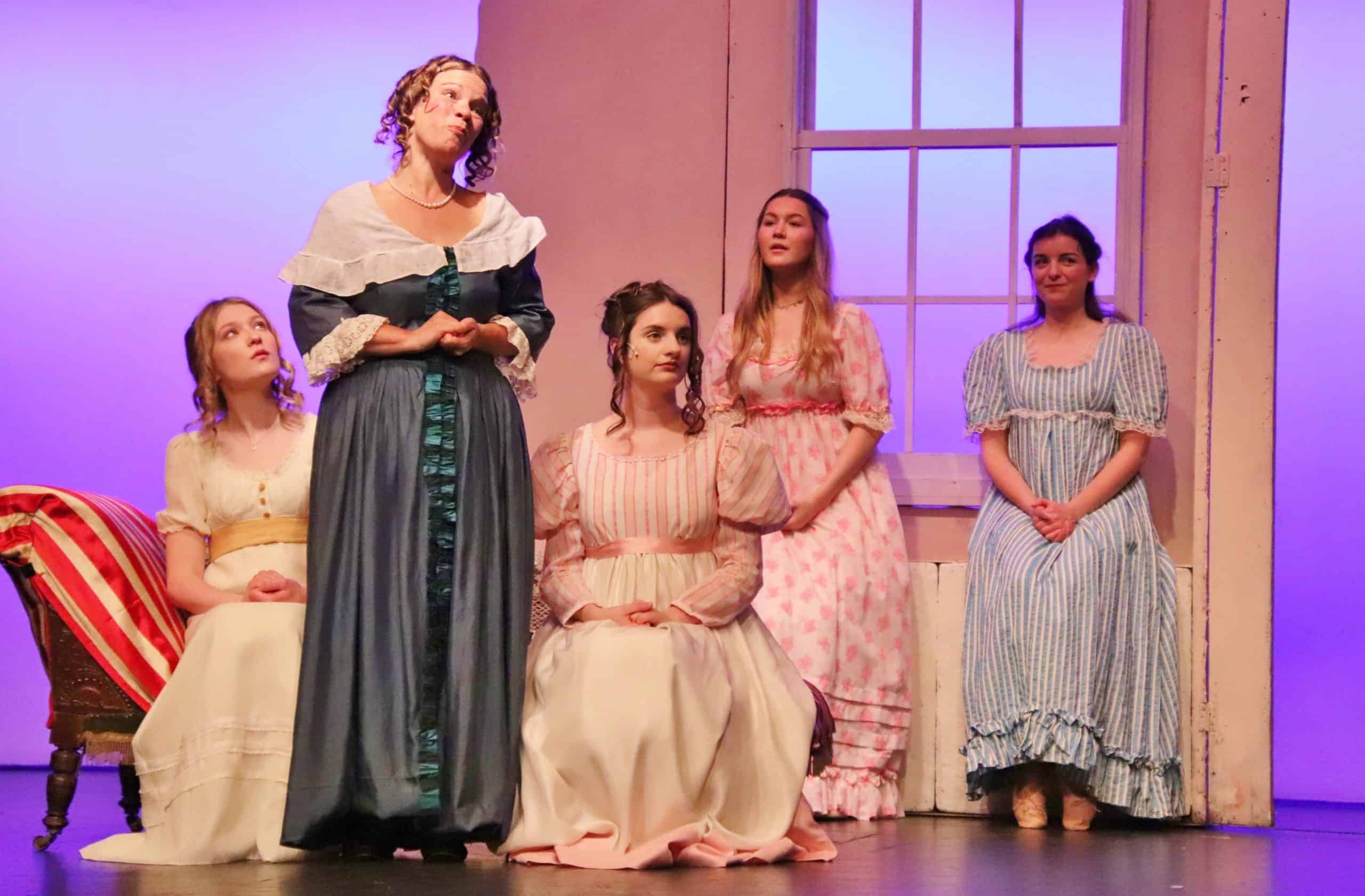
I note with satisfaction the well cast actual playing ages of all five daughters, both in relation to each other, as well as to their parents
Lizzie Mills gave a mature, beautifully observed, performance as Jane Bennet in this “other most important to marry” daughter role. Lizzie looks born to be on the stage.
Spirited and individualistic characterisations of the other three daughters, Mary, Kitty and Lydia were given in fine style by Phoebe Sleeman, Lily Brown and Katie Bartholomew respectively.
Sean Eldridge gave a beautifully observed characterisation to Fitzwilliam Darcy as his initial distance of manner hid a decency and maturity which became more evident as the play unfolded. Peter Calver shone as the more immediately affable Charles Bingham, his natural stage presence and clear diction attracting the eye and ear, as ever.
Two less wholesome characters were played to their hilt by Danniel Horton as the handsome, but morally shady George Wickham and by Steve Jones as the pompous Mr Collins. Both impressed!
Catherine Elliott clearly relished the rewarding role of the decidedly haughty Caroline Bingley.
In a large cast, all of whom ranged from very good to excellent, others who really stood out in smaller roles were these: Joanna Silcox as the upper crust harridan Lady Catherine de Bourgh; Jackie Barrett as Mrs Reynolds; Ian Caldecourt as Colonel Fitzwilliam and Philippa Lucas as Charlotte Lucas.
Lighting by Stephen Tickell and sound by John Chinnock were skilfully handled too. Stage manager Muriel Lister and her crew ensured a swift and seamless flow of the many scenes.
All in all, this was a top class production marvellously directed by Peter Reed, who also designed the realistic set.
Jon Fox
Area 19